
October 13, 2026
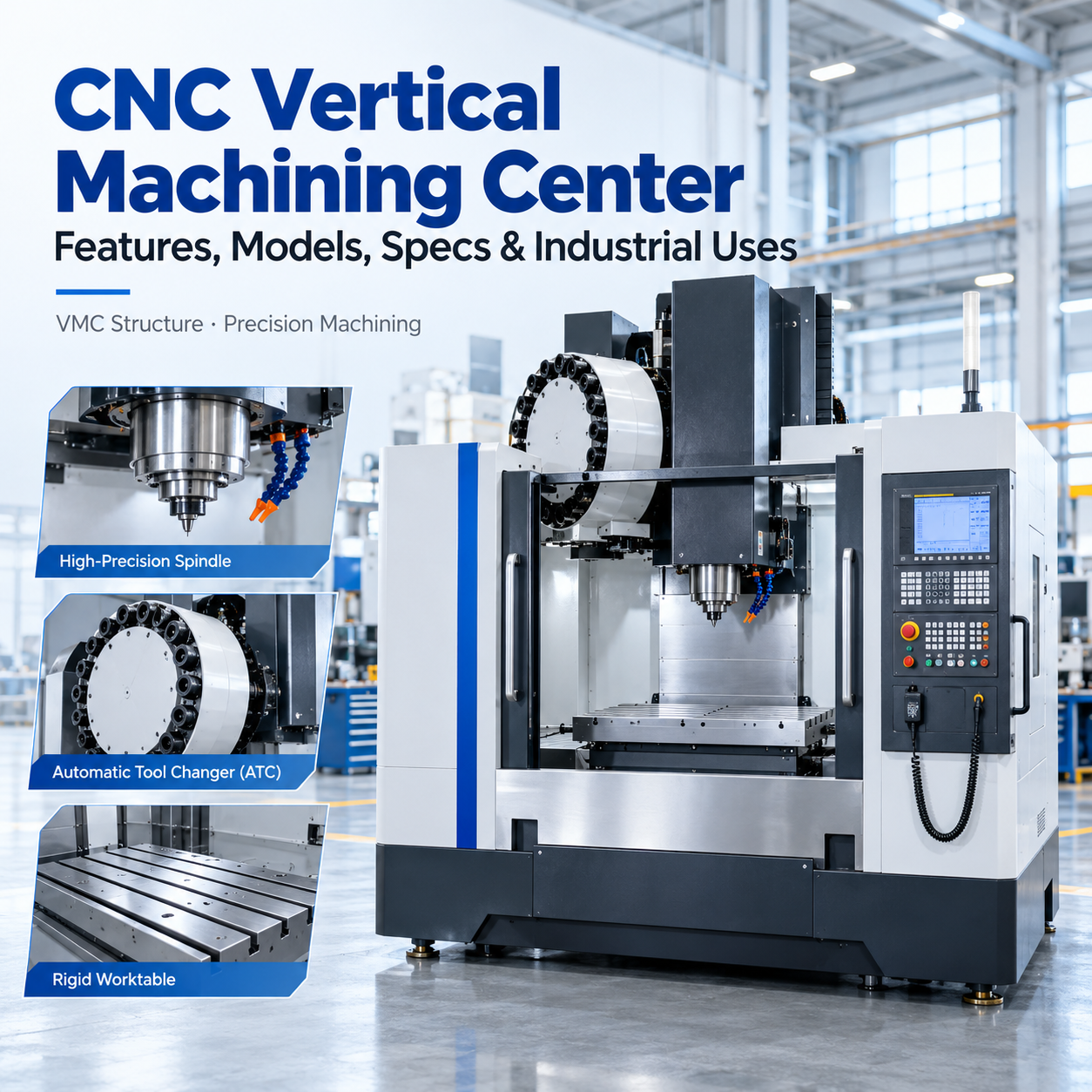
Table of Contents
1. Introduction
2. What Is a CNC Vertical Machining Center
3. Core Structural Components
4. Common VMC Model Specification Comparison
5. Key Industrial Applications
6. Practical Operation & Selection Tips
7. Frequently Asked Questions
1. Introduction
Modern metal fabrication needs high precision and stable repeatability. Manual milling and basic machine tools cannot meet modern manufacturing standards anymore.
CNC Vertical Machining Center becomes the mainstream equipment for precision metal processing. It integrates automatic cutting, drilling and tapping functions in one single machine unit.
It widely used in mold making, automotive parts and aerospace component production. Its vertical spindle layout bring unique advantages in flat surface machining.
2. What Is a CNC Vertical Machining Center
A CNC Vertical Machining Center (VMC) is a computer-controlled milling machine. It features a vertically oriented spindle axis.
The spindle moves up and down on the Z-axis. The worktable moves on X and Y axes to complete multi-directional cutting tasks.
Most standard VMC equipment support 3-axis linkage machining. Advanced models add 4-axis or 5-axis function for complex part shaping.
Automatic Tool Changer (ATC) is a standard configuration. It reduce manual tool replacement time and improve continuous production efficiency.
3. Core Structural Components
3.1 Vertical Spindle System
The spindle is the core power part of the CNC Vertical Machining Center. Standard spindle speed ranges from 8000 RPM to 12000 RPM for general models.
High-speed direct-drive spindles can reach 15000 RPM or higher. It fit fine finishing and smooth surface processing needs.
BT40 spindle taper is the most common specification. It balance cutting rigidity and tool compatibility for most industrial scenarios.
3.2 Linear Guideway & Ball Screw
High-precision linear guideways support stable axis movement. Precision ball screws ensure tiny positioning errors during repeated processing.
These two parts decide the long-term accuracy stability of the whole machine. High-quality configurations keep error within 0.003 mm for repeated positioning.
3.3 CNC Control System
FANUC and GSK systems are the most widely used control units. They support simple programming and stable long-hour operation.
The system read machining codes and control spindle speed, feed rate and axis travel automatically.
4. Common VMC Model Specification Comparison
Different VMC models have different travel ranges, power and precision parameters. The verified industry data below shows clear differences for equipment selection.
VMC Model | X/Y/Z Travel (mm) | Spindle Power (kW) | Max Spindle Speed (RPM) | Repeat Positioning Accuracy (mm) |
VMC650 | 600/500/500 | 7.5 | 8000 | ±0.003 |
VMC850 | 800/500/500 | 7.5 | 8000 | ±0.003 |
VMC855 | 800/550/550 | 11 | 10000 | ±0.0025 |
VMC1160 | 1100/600/600 | 15 | 12000 | ±0.002 |
Small models like VMC650 suit small batch and light cutting work. Large models like VMC1160 have higher power and larger travel for heavy-duty machining.
Higher spindle power and precision bring better finished surface quality. It also support harder material cutting such as alloy steel and stainless steel.
5. Key Industrial Applications
CNC Vertical Machining Center cover most precision machining industries. It replace traditional manual milling machines in most factories.
Mold Manufacturing: VMC machines process plastic molds and die-casting molds. The high precision ensure tight mold fitting and stable product output.
Automotive Parts: It machine engine accessories, brake parts and chassis components. Mass production mode reduce production error rate greatly.
Aerospace Components: High-precision VMC models process lightweight alloy parts. It meet strict industry tolerance standards.
Electronic Hardware: Small precision parts for consumer electronics all rely on stable VMC machining performance.
6. Practical Operation & Selection Tips
Factory buyers choose VMC models based on workpiece size first.
Workpiece length and width need match machine X and Y travel. Too small travel will cause processing limitations.
Material hardness decide spindle power. Hard metal materials need high-power spindle to avoid tool vibration.
Daily maintenance affect machine service life. Regular rail cleaning and lubrication keep long-term machining accuracy.
7. Frequently Asked Questions
Q1: What is a CNC Vertical Machining Center used for?
It completes precision milling, drilling, tapping and contour cutting on metal workpieces. It widely used for mold, automotive, aerospace and hardware part manufacturing.
Q2: What is the difference between VMC650 and VMC1160?
VMC1160 has larger axis travel, higher spindle power and better precision. It handle larger workpieces and heavier cutting tasks than VMC650.
Q3: Is BT40 spindle suitable for most machining work?
Yes. BT40 spindle taper offer good rigidity and tool compatibility. It fit 90% of general precision machining and mass production tasks.
Q4: How to guarantee VMC long-term accuracy?
Keep regular rail lubrication, clean cutting debris timely, and avoid long-time overload cutting. These daily maintenance steps prevent accuracy drift effectively.